FRAME TIME
100%
© 2026 Orbital Overview
See precipitation, cloud structure, and electrically active storms in one clean map built for fast situational awareness.
Orbital Overview combines NOAA MRMS precipitation data with NOAA MRMS-derived lightning activity to show where storms are producing electrical signals in near real time. Radar, satellite, and lightning density layers help users quickly understand storm intensity, movement, and nearby lightning risk.
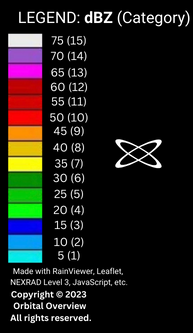
Toggle the Lightning layer to see areas of recent electrical storm activity across the contiguous United States. The lightning density layer helps highlight where storms are most electrically active, making it easier to spot strengthening cells near your location.
MRMS stands for Multi-Radar Multi-Sensor. It is a NOAA system that blends data from multiple radars, observations, satellite information, forecast models, and lightning detection systems into gridded weather products. Orbital Overview uses NOAA MRMS public datasets to help display precipitation intensity and lightning activity in a clean, map-based view.
Switch to the Satellite view for infrared cloud-top imagery. Colder (higher-altitude) cloud tops appear brighter, making it easy to spot developing thunderstorms, tropical systems, and large-scale weather patterns even at night.
Press Play to animate the last several radar frames and watch storms develop and move in real time. Step through frames manually with the forward and back controls to pinpoint exactly when precipitation or electrical storm activity reached a location.
The Lightning layer highlights NOAA MRMS-derived lightning density and recent electrical storm activity. It helps show where thunderstorms are becoming electrically active.
No. Orbital Overview displays lightning activity using NOAA MRMS-derived gridded weather products, not raw individual strike redistribution.
The NOAA MRMS precipitation data updates approximately every 2 minutes, providing one of the fastest refresh rates available for public weather radar.
MRMS stands for Multi-Radar Multi-Sensor. It is a NOAA system that blends data from multiple radars, observations, satellite information, forecast models, and lightning detection systems into gridded weather products. Orbital Overview uses NOAA MRMS public datasets to help display precipitation intensity and lightning activity in a clean, map-based view.
No. Orbital Overview is for situational awareness. Always follow official National Weather Service watches, warnings, and emergency guidance.
Radar and lightning density data are derived from NOAA MRMS public datasets. Map data © OpenStreetMap contributors. Orbital Overview is not affiliated with or endorsed by NOAA, the National Weather Service, or any government agency. Always follow official National Weather Service warnings for life-safety decisions.